
If you've passed HSK 4, you can use Chinese in everyday life. You can handle familiar topics and increasingly complex sentences, even if fast conversations and unfamiliar material still take effort. HSK 5 is where material written for native speakers starts to come within reach.
The official description says an HSK 5 learner can read Chinese newspapers and magazines, enjoy Chinese films and TV programs, and give an extended speech in Chinese. In practice, how comfortably you can do those things depends on the topic and how much you use Chinese beyond exam prep. A familiar TV show or an article about something you know may become manageable with subtitles or a dictionary, even while an unfamiliar novel remains difficult. That's still a real shift from HSK 4.
It's also the biggest step in the six-level HSK 2.0. The vocabulary grows from 1,200 to 2,500 words, so you're adding 1,300 new words, more than the previous four levels combined. The exam gets longer, the reading passages become more demanding, and the writing section moves from individual sentences to short compositions. A lot of learners pass HSK 4 and then stay there for a long time.
This guide covers what the HSK 5 exam tests, what makes its vocabulary different, the grammar you'll need for reading formal Chinese, and how to adjust your study habits as the material becomes more demanding.
What's on the HSK 5 Exam
The HSK 5 written exam covers listening, reading, and writing. It has 100 questions and a maximum score of 300, with 100 points for each section. The official HSK 5 page doesn't state a pass mark, but 180 is the widely used benchmark, and universities and employers set their own score requirements. At about 125 minutes, including 5 minutes for filling in personal details, the exam is about 20 minutes longer than HSK 4, so stamina matters.
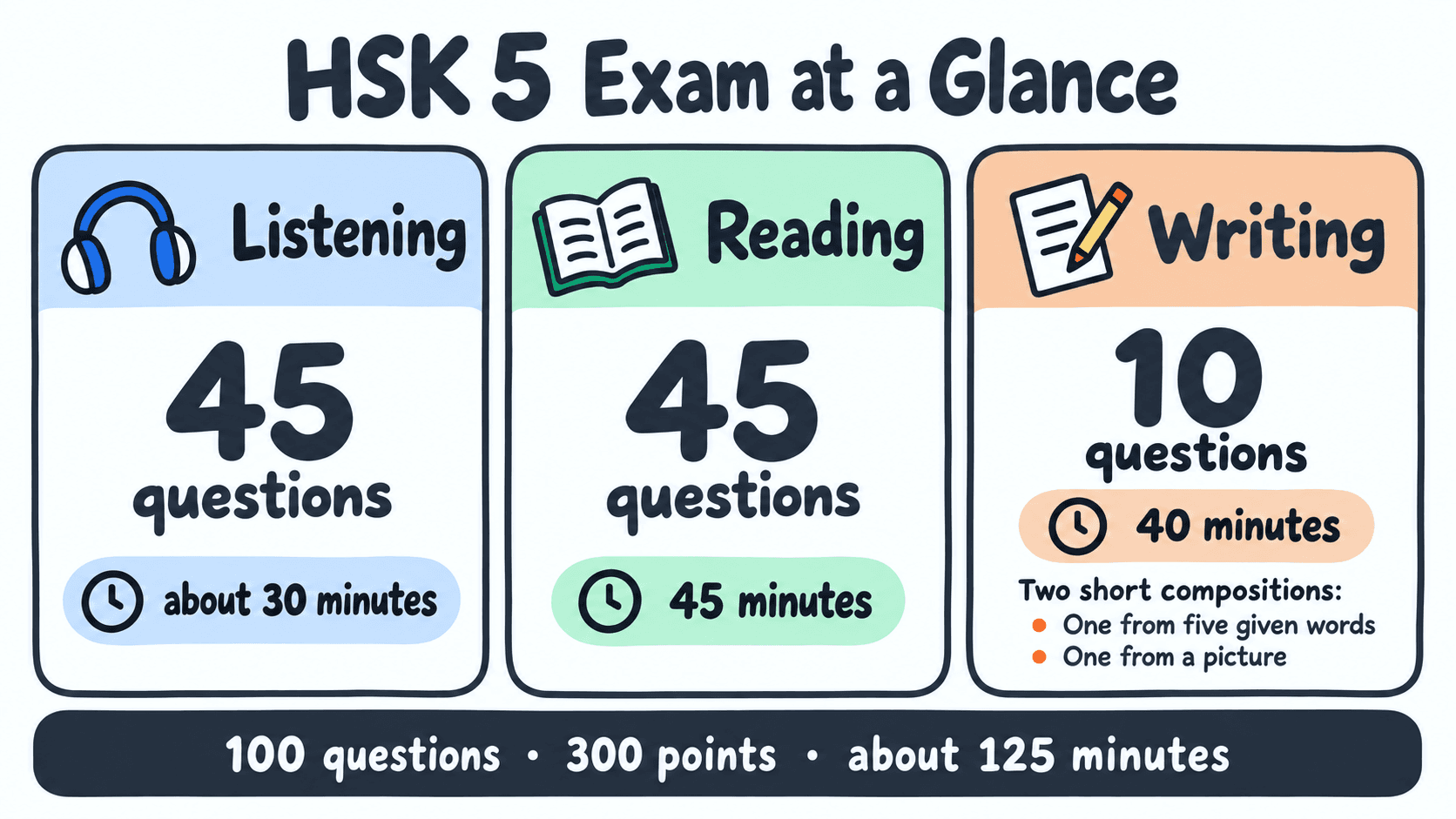
Listening (45 questions): Short dialogues come first, followed by longer dialogues and spoken passages with one or more questions each. As at HSK 4, each recording plays once. You'll hear situations and opinions involving everyday life, work, and wider social topics, with more demanding vocabulary and longer stretches of speech to follow.
Reading (45 questions): Three parts. First, passages with gaps where you choose the word that fits the context. Second, short passages where you select the statement that matches the content. Third, longer passages with multiple comprehension questions. You have 45 minutes for the section, so you need both accurate comprehension and the ability to find relevant information efficiently.
Writing (10 questions): Two parts. The first is eight sentence-rearrangement questions, familiar from HSK 4. The second introduces two short compositions of about 80 Chinese characters each. One gives you five words that you must all use in your piece. The other gives you a picture to write about. HSK 4 already asks you to create individual sentences from pictures and supplied words; HSK 5 asks you to connect your ideas into short passages.
Speaking: The HSK 5 written exam does not include a speaking section. In the HSK 2.0 framework, speaking is assessed separately through the HSKK (汉语水平口语考试), with HSK 5 and 6 paired with HSKK Advanced. Check whether your test center requires you to register for both, as well as whether your university or employer requires a speaking score.
A note on HSK versions: The vocabulary counts and exam format in this guide refer to HSK 2.0. HSK 3.0, part of a three-stage, nine-level framework, is scheduled to launch globally on December 13, 2026. Its syllabus and exam format differ from those described here. Check the official HSK website and your test center to confirm which version you will take.
What HSK 5 Vocabulary Looks Like
The jump to 2,500 words is a lot on its own, but the bigger change is the kind of words you're learning. HSK 5 stretches your Chinese in two directions at once: toward the formal language of newspapers, and toward the casual language of real conversation.
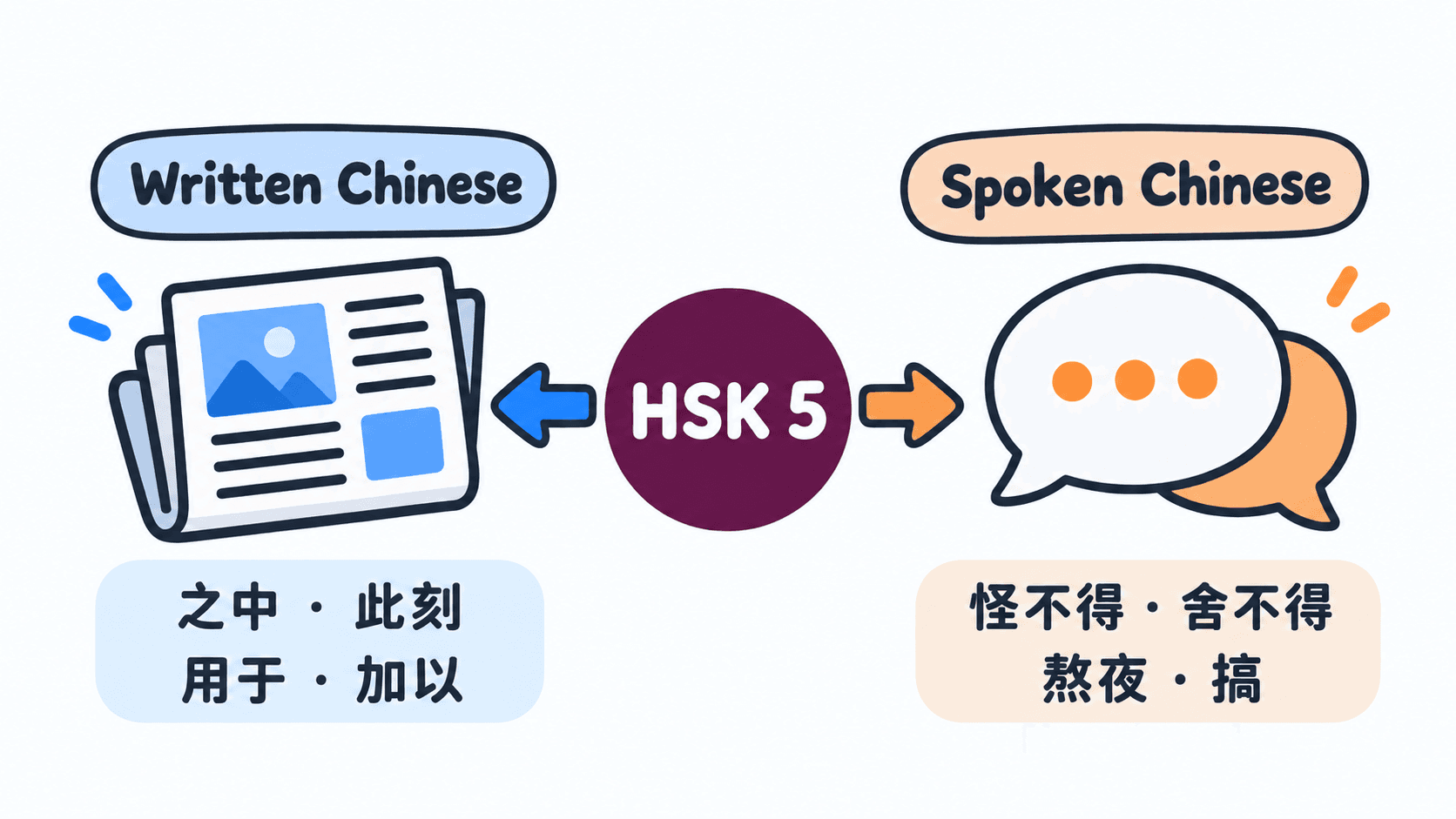
Written Chinese, built from classical pieces. Modern written Chinese is full of small leftovers from classical Chinese. You've met a few already, but at HSK 5 they show up everywhere:
- 之 (zhī) in 之中 (among), 之内 (within), 之外 (outside of), 之下 (under)
- 此 (cǐ) in 此刻 (at this moment), 此后 (after this), 如此 (like this, so), 由此 (from this)
- 于 (yú) in 便于 (easy to), 出于 (out of, for the sake of), 用于 (used for), 低于 (lower than)
- 其 (qí, its/their) and 则 (zé, then/however) on their own
None of these words are hard individually. The challenge is that they make a sentence look unfamiliar even when you know every other word in it. 这种材料主要用于建筑 (this material is mainly used in construction) is a simple sentence, but 用于 makes it read like a newspaper. Once you can spot these pieces, a large part of formal Chinese stops looking opaque.
Spoken Chinese gets more casual, too. At the same time, HSK 5 adds words you'll hear constantly in TV dramas and between friends: 搞 (gǎo, to do or deal with), 熬夜 (áoyè, to stay up late), 怪不得 (guàibude, no wonder), 舍不得 (shěbude, to hate to part with), 忍不住 (rěnbuzhù, can't help but), 用不着 (yòngbuzháo, there's no need), and 打交道 (dǎ jiāodao, to deal with people). These aren't formal, but they're what makes conversation sound natural.
怪不得你这么累,原来昨晚又熬夜了。(guàibude nǐ zhème lèi, yuánlái zuówǎn yòu áoyè le.)
No wonder you're so tired. You stayed up late again last night.
Vocabulary for the news. HSK 5 gives you the words to follow what's happening in the world. A few clusters you'll meet:
- Economy: 利润 (lìrùn, profit), 成本 (chéngběn, cost), 消费者 (xiāofèizhě, consumer), 产业 (chǎnyè, industry), 物价 (wùjià, prices)
- Law and society: 法规 (fǎguī, regulations), 治安 (zhì'ān, public order), 公正 (gōngzhèng, fair), 权力 (quánlì, power), 争议 (zhēngyì, controversy)
- Disasters: 灾害 (zāihài, disaster), 救灾 (jiùzāi, disaster relief), 消防 (xiāofáng, firefighting)
Character families still help here. The 灾 (zāi, disaster) family alone gives you 灾区 (disaster area), 灾害, 灾难 (catastrophe), 受灾 (to be hit by disaster), 救灾, 水灾 (flood), and 火灾 (fire). If you built the word-family habit at HSK 3 and 4, this is where it pays off.
Words for what's going on inside. HSK 4 gave you the words to say what you think. HSK 5 gives you the words to describe how you feel and why: 犹豫 (yóuyù, to hesitate), 慌张 (huāngzhāng, flustered), 惭愧 (cánkuì, ashamed), 委屈 (wěiqu, feeling wronged), 悲观 (bēiguān, pessimistic), 珍惜 (zhēnxī, to cherish). These words let you follow a character's inner life in a novel or drama, not just the plot.
The words around a word matter more. At HSK 4, near-synonyms were the main challenge. At HSK 5, the challenge is collocation: knowing which words naturally go together. Take 删除 (shānchú), 排除 (páichú), and 消除 (xiāochú). All three can translate as "remove" or "eliminate." But you 删除 a file (删除文件), you 排除 a possibility (排除可能), and you 消除 a misunderstanding (消除误会). Swap them and the sentence sounds wrong to a native speaker, even though the dictionary meanings look interchangeable.
You'll also meet a handful of four-character idioms at this level, such as 名胜古迹 (famous scenic spots and historic sites). Fittingly, the word 成语 itself is an HSK 5 word. If you want a head start, our guide to Chinese idioms is a good place to begin.
For the complete word list, check out our HSK 5 vocabulary chart, or browse other levels on our HSK charts page.
Key Grammar Patterns at HSK 5
By HSK 5, you already know the core grammar of Chinese. What's new is mostly the grammar of written Chinese: connectors and structures that appear in articles, essays, and formal speech far more often than in conversation.
何况 (hékuàng). "Let alone" or "not to mention." Used to build toward a stronger point, often after a 连…都 clause you learned at HSK 3.
这道题连老师都觉得难,何况学生呢?(zhè dào tí lián lǎoshī dōu juéde nán, hékuàng xuésheng ne?)
Even the teacher finds this question hard, let alone the students.
宁可…也… (nìngkě…yě…). "Would rather… than…" It expresses a preference while admitting there's a cost.
我宁可走路,也不想挤公交车。(wǒ nìngkě zǒulù, yě bù xiǎng jǐ gōngjiāochē.)
I'd rather walk than squeeze onto a packed bus.
以便, 从而, 因而, 由此 (yǐbiàn, cóng'ér, yīn'ér, yóucǐ). Formal ways to express purpose and result. 以便 means "so that," 从而 and 因而 mean "thereby" or "as a result," and 由此 means "from this." You'll see them constantly in news writing.
公司降低了成本,从而提高了利润。(gōngsī jiàngdī le chéngběn, cóng'ér tígāo le lìrùn.)
The company cut its costs, thereby increasing its profits.
毕竟 (bìjìng). "After all." It's extremely common and hard to translate well, because it often softens a judgment by pointing to a fact everyone accepts.
别生他的气了,他毕竟还是个孩子。(bié shēng tā de qì le, tā bìjìng hái shì ge háizi.)
Don't be angry with him. He's still a kid, after all.
不免 (bùmiǎn). "Can't help but" or "inevitably." Used to comment on a reaction that's natural given the situation.
第一次上台演讲,不免有点儿紧张。(dì yī cì shàngtái yǎnjiǎng, bùmiǎn yǒudiǎnr jǐnzhāng.)
Giving a speech for the first time, it's natural to feel a little nervous.
加以 + verb (jiāyǐ). This one looks strange at first because 加以 adds almost no meaning. It's a formal frame placed before a two-syllable verb, making the sentence sound official.
这个问题需要加以研究。(zhège wèntí xūyào jiāyǐ yánjiū.)
This problem needs to be studied.
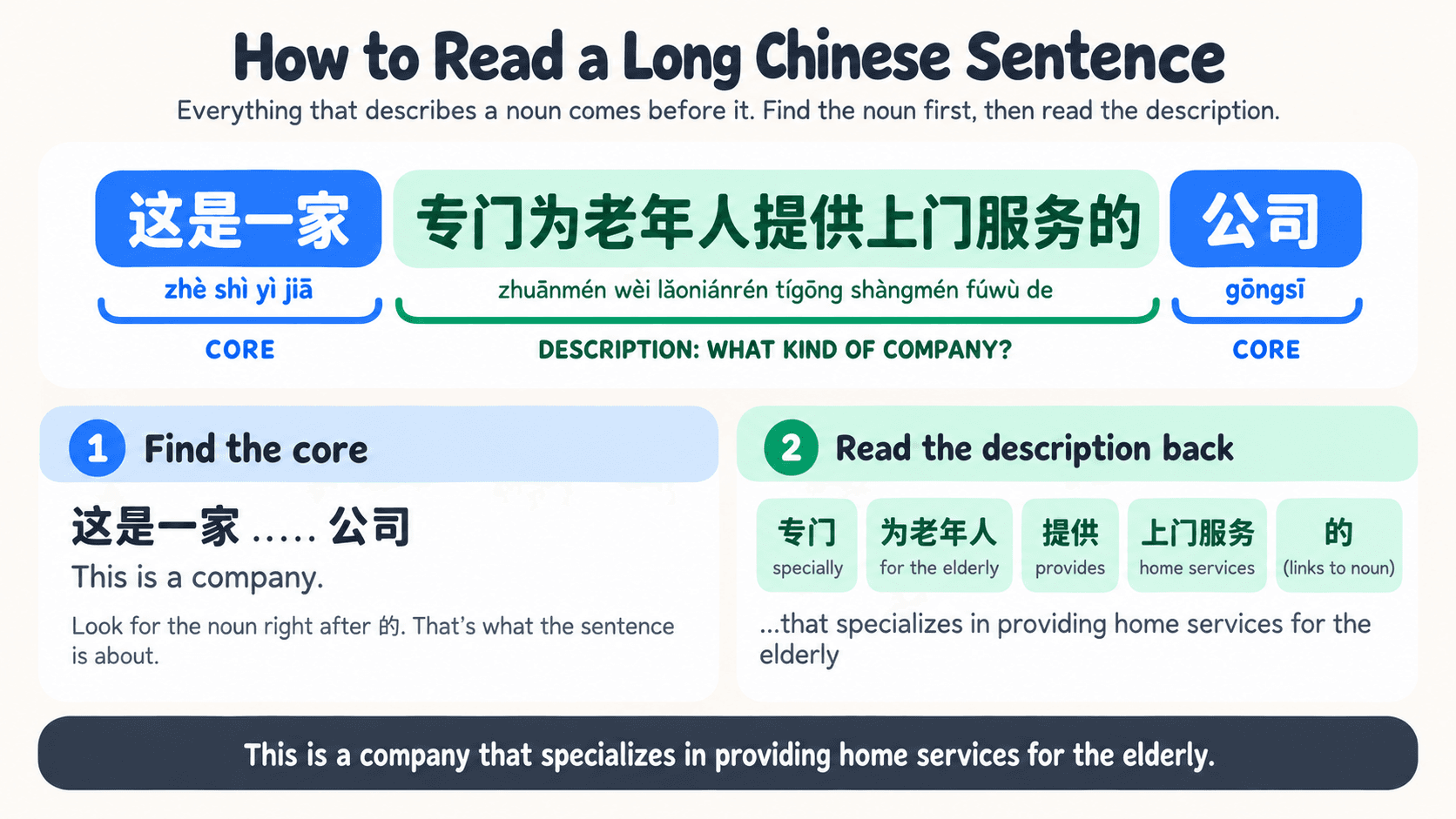
Long sentences with stacked descriptions. In written Chinese, everything that describes a noun comes before it, joined by 的. In newspapers, that description can get very long. The trick is to find the noun at the end first, then read the description back.
这是一家专门为老年人提供上门服务的公司。(zhè shì yì jiā zhuānmén wèi lǎoniánrén tígōng shàngmén fúwù de gōngsī.)
This is a company that specializes in providing home services for the elderly.
Strip it down and the core is simply 这是一家公司 (this is a company). Everything between 一家 and 公司 describes what kind of company it is. Practicing this kind of breakdown is one of the most useful things you can do for the HSK 5 reading section.
How to Study HSK 5 Vocabulary Effectively
Everything that worked at HSK 4 still applies: reading every day, learning word families, writing regularly, and reading past words you don't know. HSK 5 asks for a few more shifts on top of those.
Learn words with their partners. Instead of learning 提高 (to raise) on its own, learn 提高水平 (to raise one's level). Instead of 排除 (to rule out), learn 排除可能 (to rule out a possibility). Collocations are what make your Chinese sound natural, and they're exactly what the fill-in-the-blank reading questions test. When you add a new word to your review, add the phrase you found it in.
Practice reading against the clock. The HSK 5 reading section rewards speed. Time yourself on passages, and practice reading the questions before the text so you know what you're looking for. Skim once for the overall structure, then go back for detail. It feels uncomfortable at first if you're used to reading every word carefully, but it's a skill that improves quickly with practice.
Write a short paragraph every day. Pick five words from your review list and write about 80 characters that use all of them. This mirrors the composition task directly, and it forces you to actually produce the vocabulary you've been reviewing. Don't worry about writing something interesting. Writing something at all is the point.
Make news part of your reading. News is where formal vocabulary and written grammar live. If you're seeing 由于, 从而, and 之中 for the first time in a practice exam, it will slow you down. If you've already seen them in dozens of articles, you'll read right past them. Graded news, written at your level and about real events, is the easiest way to get that exposure without the frustration of jumping straight into a Chinese newspaper.
Listen to both registers. For formal Chinese, shadow short news clips: listen to a sentence, pause, and repeat it. For casual Chinese, watch dramas or vlogs with Chinese subtitles and notice the spoken words like 怪不得 and 舍不得. The HSK 5 listening section draws on both, and so does real life.
How Long Does It Take to Pass HSK 5?
The official HSK 5 profile targets learners who have studied Chinese for more than two years, at two to four class hours per week. Self-study learners often move faster or slower than that, depending on how they study.
As a rough benchmark: coming from HSK 4 with solid habits and studying an hour a day, eight months to a year is realistic, and longer is common. That's a longer stretch than any previous level, which makes sense given that you're learning more new words than at all the previous levels combined. These are estimates, not guarantees.
As with HSK 4, the biggest variable is reading. Learners who read every day tend to land on the shorter end of that range, because at HSK 5 there's simply too much vocabulary to learn in isolation. The words have to come from meeting them, again and again, in real sentences.
What HSK 5 Opens Up
Passing HSK 5 is a real turning point. It's the level many Chinese-taught degree programs ask for, and it's the point where native material becomes something you can actually use: news articles, TV dramas, podcasts, and eventually books. You won't understand everything, but you'll understand enough to keep going, and that's what makes it possible to keep learning from real Chinese rather than from textbooks.
HSK 6 is the next step, with a cumulative vocabulary of around 5,000 words. By that point, the challenge is less about new grammar and more about hours: how much you read and listen. The habits you build at HSK 5 are the ones that carry you there.
If you're still working toward this level, our HSK 4 guide covers the step before. And if you're looking for HSK 5-level reading material to practice with, Pandaist has over a thousand articles graded by HSK level, including news, with built-in vocabulary support, pinyin, and grammar explanations. It's a good way to put all those new words to work.