
If you've passed HSK level 2, congratulations. You've got the basics down! You can now introduce yourself, order food, and handle simple conversations. But HSK level 3 is where Chinese starts to get real.
At this level, you're moving beyond survival phrases. You'll need to express opinions, describe experiences, and follow more complex conversations. The vocabulary requirement grows significantly, with around a thousand words expected in total, and many of the new additions are more abstract and harder to pin down than anything you've studied before.
This is also the level where a lot of learners hit a wall. The beginner momentum fades, the words get harder to memorize, and progress feels painfully slow. If that sounds familiar, you're not alone.
The good news? With the right approach, HSK 3 is completely manageable. This guide covers what to expect from the exam, which vocabulary areas deserve the most attention, and how to study effectively at this stage so the words actually stick.
What's on the HSK 3 Exam
The HSK 3 written exam covers listening, reading, and writing. It has 80 questions and a total score of 300 points, with 180 required to pass.
Listening (40 questions): You’ll hear short dialogues and statements and answer questions, typically multiple-choice. The pace picks up compared to earlier levels, so being able to recognize vocabulary by ear, not just on paper, becomes important.
Reading (30 questions): This section uses a mix of question types, often including matching, fill-in-the-blank, and short passages with comprehension questions. The texts are still manageable, but noticeably longer and more varied than at HSK 2.
Writing (10 questions): You'll work on structured tasks like rearranging words into correct sentences. It's not free-form essay writing, but it does require a solid grasp of word order and sentence structure.
Speaking (required in HSK 3.0 rollout*): Under the new HSK 3.0 standard, candidates taking levels 3 through 6 must also register for the corresponding oral test. For HSK 3, this is typically aligned with HSKK Basic (初级) exam, a roughly 20-minute test that involves listening and repeating sentences, answering short questions, and giving spoken responses to prompts. If you've been studying primarily through reading and flashcards, it's worth building some speaking practice into your routine early.
* A note on HSK versions: The HSK is currently in transition. The new HSK 3.0 standard had its first global pilot exam on January 31, 2026, with the new syllabus marked for implementation in July 2026, though timing may vary by test center. Check the official HSK website for the latest on exam formats and scheduling in your area. Regardless of which version you sit, the core vocabulary and skills covered in this guide apply to both.
What HSK 3 Vocabulary Looks Like
If HSK 1 and 2 gave you the building blocks for daily conversation, HSK 3 is where things start to feel noticeably different. You'll be adding roughly 500 to 1,000 new words, depending on the standard, and many of them are a real step up from what you're used to.
More abstract, harder to picture. At HSK 2, most words map neatly to things you can see and do: eat, drink, buy, go. At HSK 3, you'll start encountering words that are much harder to visualize:
- 保持 (bǎochí) - to maintain
- 产生 (chǎnshēng) - to produce, to generate
- 存在 (cúnzài) - to exist
- 表达 (biǎodá) - to express
- 处理 (chǔlǐ) - to handle, to deal with
These are the kinds of words that make reading real Chinese possible, but because they're abstract, they rarely stick with flashcards alone. You need to see them used in context.
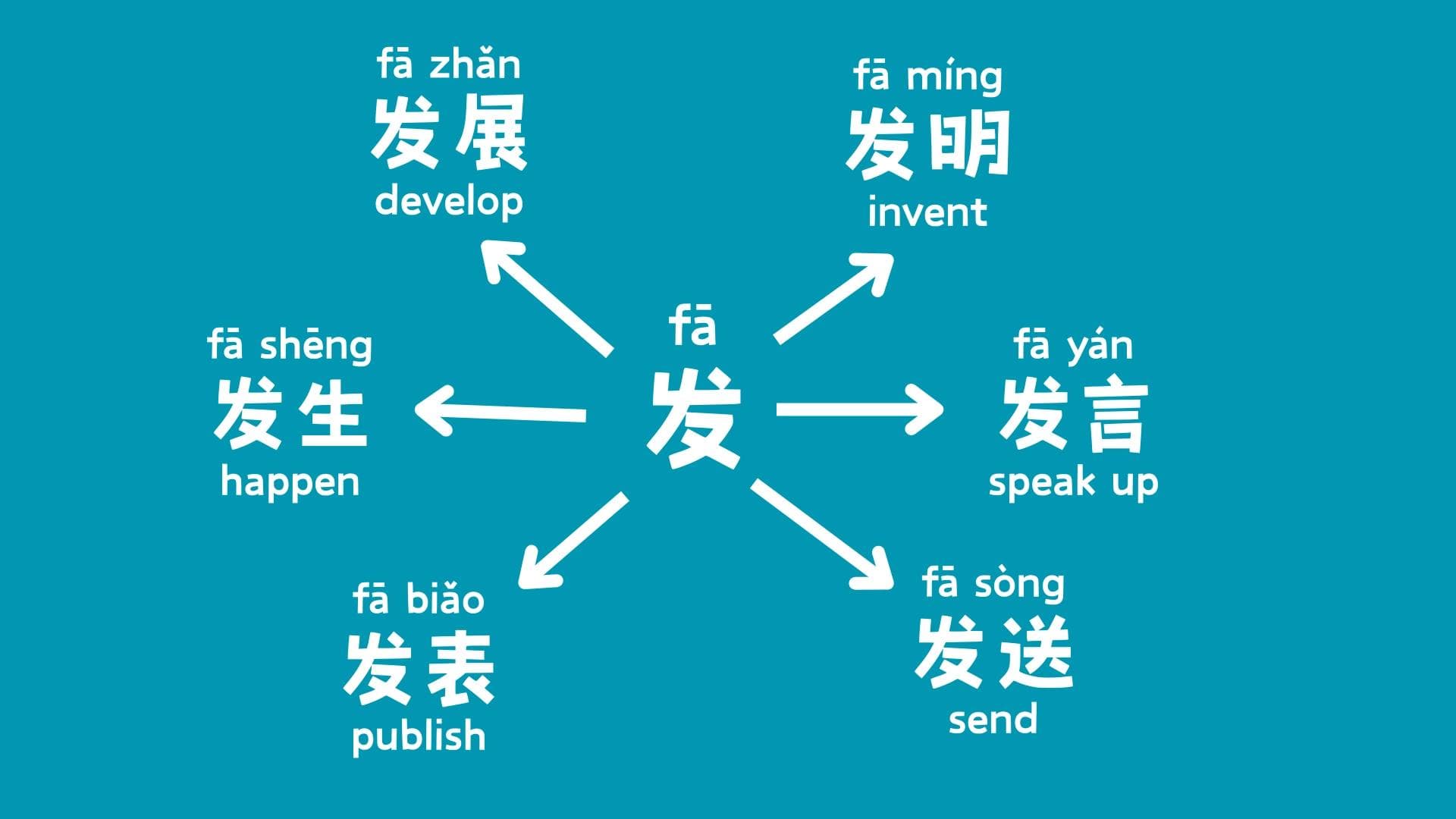
Word families that multiply fast. One of the biggest shifts at HSK 3 is how a single character suddenly spawns an entire family of compounds. Take 发 (fā): at earlier levels, you might know 发现 (discover). Now you need to keep track of 发生 (happen), 发展 (develop), 发明 (invent), 发表 (publish), 发言 (speak up), 发达 (developed), 发送 (send), and 发动 (launch). That's eight new words from one character. The same thing happens with 成: 成功 (succeed), 成果 (result), 成立 (establish), 成熟 (mature), 成长 (grow up), 成员 (member), 成就 (achievement). Learning to recognize these shared-character patterns is one of the most efficient strategies at this level.
Same character, very different meanings. The flip side of word families is that HSK 3 is also full of words that share a character but pull in completely unrelated directions:
- 反对 (fǎnduì, to oppose) vs. 反应 (fǎnyìng, reaction) vs. 反复 (fǎnfù, repeatedly)
- 观察 (guānchá, to observe) vs. 观念 (guānniàn, concept) vs. 观众 (guānzhòng, audience)
This is where mix-ups really start, and it's one of the reasons reading in context matters so much at this stage. Seeing 反对 and 反复 in actual sentences does more for your memory than studying them side by side on a vocabulary list.
Connectors that glue ideas together. At earlier levels, your sentences mostly stood on their own. HSK 3 expects you to start linking them:
- 因此 (yīncǐ) - therefore
- 由于 (yóuyú) - due to
- 不仅 (bùjǐn) - not only
- 并且 (bìngqiě) - moreover
- 按照 (ànzhào) - according to
These are the words that make your Chinese sound structured rather than choppy, and they're essential for reading anything beyond basic dialogues.
For the complete word list, check out our HSK vocabulary charts, where you can browse words organized by level.
Key Grammar Patterns at HSK 3
HSK 3 is where Chinese grammar starts doing things that don't have easy English equivalents. You don't need to master all of these before taking the exam, but being familiar with them will make both the reading section and your general comprehension much smoother.
把 (bǎ) sentences. Instead of the usual subject-verb-object order, 把 flips things around to emphasize what happens to something. It's one of the most talked-about grammar points in Chinese, and for good reason: it feels completely unnatural at first.
请把窗户关上。(qǐng bǎ chuānghù guānshang.)
Please close the window.
被 (bèi) passive. This is how you say something was done to you or to something. Chinese doesn't use the passive as often as English does, but when it appears, it's usually to describe something unwanted or unexpected.
我的手机被弟弟摔坏了。(wǒ de shǒujī bèi dìdi shuāi huài le.)
My phone was broken by my little brother.
Result complements. These are mini add-ons after a verb that tell you the outcome of an action. You'll see patterns like 看完 (finished reading), 听懂 (listened and understood), and 做好 (finished doing properly). The tricky part is that the complement changes the meaning of the whole phrase, so 听 (listen) and 听懂 (understand by listening) aren't interchangeable.
除了...以外 (chúle...yǐwài). This structure means "besides" or "except for," depending on context. It shows up constantly in HSK 3 reading passages.
除了中文以外,她还会说法语。(chúle Zhōngwén yǐwài, tā hái huì shuō Fǎyǔ.)
Besides Chinese, she also speaks French.
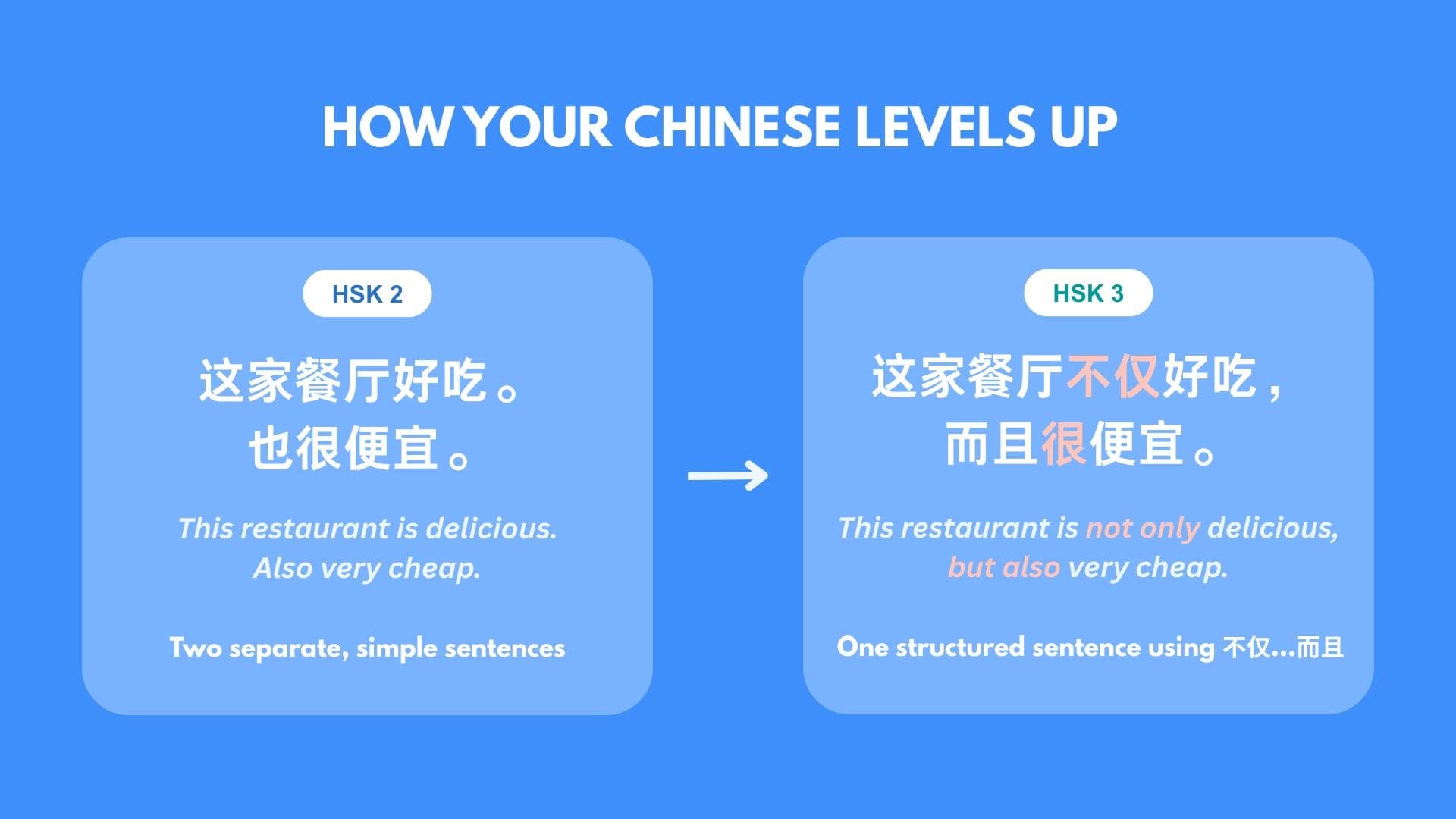
不仅...而且/也 (bùjǐn...érqiě/yě). "Not only... but also." At HSK 2, your sentences were mostly simple statements. This pattern is one of the first that lets you build layered, more expressive thoughts.
这家餐厅不仅好吃,而且很便宜。(zhè jiā cāntīng bùjǐn hǎochī, érqiě hěn piányi.)
This restaurant is not only delicious, but also very cheap.
连...都/也 (lián...dōu/yě). "Even..." This one is great for emphasis and shows up in both spoken and written Chinese.
这道题连老师都不会做。(zhè dào tí lián lǎoshī dōu bú huì zuò.)
Even the teacher can't solve this problem.
Each of these patterns comes up frequently in HSK 3 reading material. If they look intimidating on paper, don't worry. Seeing them repeatedly in context is how they start to click, which is one reason reading practice at this level is so valuable.
How to Study HSK 3 Vocabulary Effectively
At HSK 1 and 2, you can get away with brute-force memorization. The word lists are short, most words are concrete, and flashcard apps do a decent job. At HSK 3, that approach starts to break down.
The issue isn't discipline. It's that you're now dealing with hundreds of abstract words, grammar-heavy vocabulary, and compounds that only make sense in context. Drilling 产生 (to produce) or 保持 (to maintain) on a flashcard gives you a translation, but it doesn't help you feel how the word is actually used. You'll recognize it on a list and blank on it in a sentence.
Here's what works better at this stage.
Read at your level, and read a lot. This is the single most effective thing you can do for vocabulary at HSK 3. Not reading native news articles (too hard), and not re-reading textbook dialogues (too easy). Graded reading, where the content is written for your level and you encounter new words naturally inside real sentences, is what bridges that gap. When you see 发展 in a story about a city changing over time, or 反对 in a conversation about a disagreement, the meaning sticks in a way that a flashcard definition never will.

Learn word families together, not one word at a time. As we covered earlier, HSK 3 is full of characters that appear across many compounds. When you encounter a new word like 保护 (protect), take a few minutes to look at what else 保 does: 保持, 保证, 保存, 保险. You don't need to memorize the whole family at once, but noticing the pattern makes each individual word easier to remember. Your brain starts to treat the character as a building block rather than a random shape.
Pay attention to words you "kind of" know. At this level, there's a growing gap between words you can recognize when you see them and words you can actually use. You might read 处理 in a passage and think "oh right, that means handle something," but you'd never produce it in a sentence yourself. That's normal, and reading is actually the best way to close that gap. The more often you encounter a word in different contexts, the more it moves from passive recognition to active knowledge.
Don't skip the connectors. Words like 因此, 不仅, and 由于 aren't exciting to study. They don't label objects or describe actions, so they're easy to gloss over. But these are the words that let you follow the logic of a paragraph. If you're reading a passage and you don't register that 由于 means "because of," you'll miss the entire cause-and-effect structure of what you're reading. When you come across these in your reading, slow down and make sure you understand how they connect the sentences around them.
Use the exam format to guide your practice. The HSK 3 exam tests listening, reading, and writing, plus speaking under the new standard. Don't spend all your study time on just one skill. If you've been focusing mostly on vocabulary lists and reading, set aside time for listening practice too. Podcasts, short videos, or even the listening sections from past HSK papers all help. The goal is to recognize words by ear, not just by sight.
How Long Does It Take to Pass HSK 3?
There's no single answer, because it depends on how much time you put in and how you spend it. But as a rough benchmark, most learners going from HSK 2 to HSK 3 need somewhere between three and six months of consistent study, typically an hour or so per day.
If you're doing a mix of vocabulary review, grammar study, and regular reading practice, you'll likely land on the shorter end. If you're relying mainly on flashcards or only studying a few times a week, expect it to take longer.
The bigger point is that HSK 3 isn't a sprint. The vocabulary is large enough and abstract enough that cramming doesn't work well. Steady, daily exposure, especially through reading, does more than long weekend study sessions once in a while.
What Comes Next
Passing HSK 3 is a real milestone. It means you can handle everyday conversations, follow the main idea of straightforward texts, and express yourself on familiar topics. That's not nothing.
HSK 4 is where things open up further. The vocabulary roughly doubles, the grammar gets more nuanced, and you'll start engaging with longer, more complex reading material. But if you've built solid habits at HSK 3, especially around reading in context, you're already set up well for that jump.
If you're looking for HSK 3-level reading material to practice with, Pandaist has over a thousand articles graded by HSK level, with built-in vocabulary support and grammar explanations. It's a good way to put all those new words to work.